
How to Pack Kitchen Items for Shifting: Crockery, Utensils and Appliances
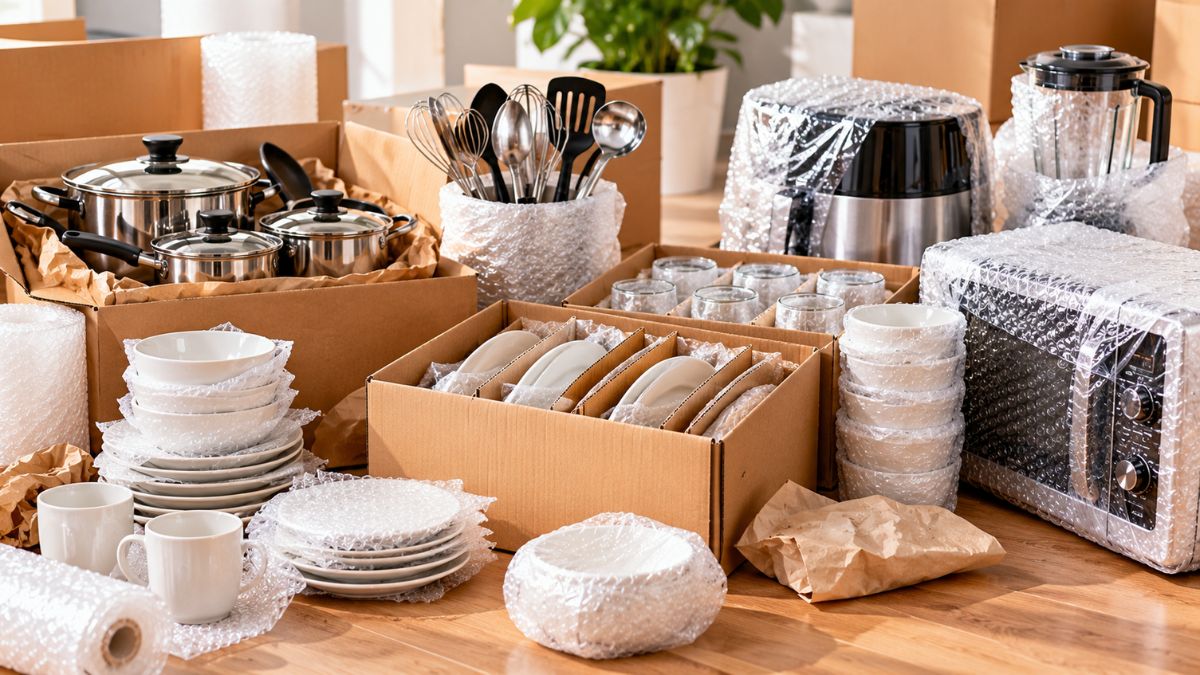
The kitchen is usually the hardest room to pack. It has the most small items, the most breakable items and the things you need right up to moving day. With the right materials and a simple order of work, you can pack your kitchen so that everything reaches your new home in good condition.
What You Need
- Strong corrugated boxes in small and medium sizes (heavy items go in small boxes).
- Bubble wrap and packing paper.
- Cell dividers for glasses, or extra cardboard to make your own.
- Stretch film, packing tape and a marker.
- Zip-lock bags for small parts and leftover dry food.
Start With What You Use Least
Pack in this order so the kitchen keeps working until the last day:
- Showcase crockery, special-occasion dinner sets and decorative items.
- Extra utensils, baking items and large serving dishes.
- Small appliances you rarely use — oven, toaster, juicer.
- Dry food stock, after using up as much as possible.
- Daily-use items last — a few plates, cups, one pan and the gas stove.
How to Pack Plates and Bowls
- Put a layer of crumpled paper at the bottom of the box as a cushion.
- Wrap each plate separately in packing paper or bubble wrap.
- Stand plates on their edge, like in a dish rack, instead of stacking them flat — they handle pressure better this way.
- Fill every gap with crumpled paper so nothing moves when the box is lifted.
- Do not make the box too heavy. Mark it FRAGILE — KITCHEN.
How to Pack Glasses and Cups
- Stuff the inside of each glass with paper, then wrap the outside.
- Use cell dividers so glasses do not touch each other.
- Pack glasses upright and keep them in the top layer of the box.
- Wrap cup handles with extra paper — they break easily.
Steel and Non-Stick Utensils
- Nest pots and pans inside each other, with a sheet of paper between non-stick surfaces to avoid scratches.
- Pack lids separately, wrapped in paper.
- Tie spoons, ladles and spatulas together in bundles.
- Wrap knives in thick paper or cardboard and tape them, with the box clearly labelled.
Kitchen Appliances
- Mixer grinder — remove the jars and blades, wrap each one, and pack them with the base.
- Microwave or OTG — remove the glass plate and wrap it separately; tape the door shut.
- Refrigerator — empty, defrost the night before and dry it so it does not smell.
- Water purifier — drain the water and keep the fittings in a labelled bag.
- Chimney and hob — get them uninstalled by a technician if they are fixed to the wall.
If you still have the original boxes for appliances, use them — they fit best.
Gas Cylinder and Stove
Gas cylinders that are not empty, along with other flammable items, are not moved with household goods for safety reasons. Disconnect the stove, close the regulator, and arrange the cylinder transfer with your gas agency. Pack the stove separately with its pipe and regulator in a labelled bag.
Food Items
- Use up perishable food in the last week before the move.
- Seal opened packets of dal, rice, spices and flour in zip-lock bags or tight containers.
- Keep oil, ghee and sauces in a separate box with a plastic lining, in case of leaks.
- Perishable food is not moved, so plan simple meals for moving day.
Label Clearly
Write on each box what is inside and which shelf or cupboard it should go to — for example "Kitchen — glasses, top cupboard". Unpacking becomes much faster when every box tells you where it belongs.
Keep a First-Day Kitchen Box
Pack one box you will open first at the new home: a kettle or small pan, a few plates, cups and spoons, a knife, tea, sugar, biscuits, a dish sponge and a towel.
Let Our Team Pack Your Kitchen
If you prefer not to pack yourself, the Century Packers and Movers team packs crockery, utensils and appliances with bubble wrap, corrugated boxes and stretch film. Read about our packers and movers service or get a free quote.